
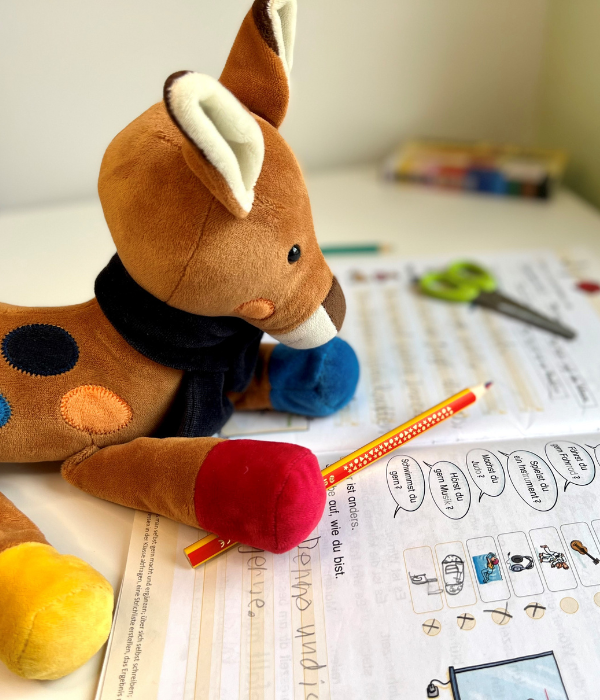
Since January 2021, I have been working as an early childhood educator in the “Fit for School” project at the Center for Pediatric and Adolescent Medicine at UKHD and at KiTZ. As a special education teacher, early childhood educator, and licensed nurse, I support children from about four and a half years old until they start school. The goal is to foster important skills for starting school, such as motor skills, perception, concentration, memory, language, and logical thinking. I care for many children during extended or recurring hospital stays. This allows me to continuously monitor their development and tailor my support to each child’s individual needs.
One example is six-year-old Maximilian*. Since early childhood, he has been in and out of medical treatment due to various illnesses. After battling cancer, he developed a very rare neurological disorder that, among other things, causes epileptic seizures. When I first met Maximilian at just under six years old, he showed unsteadiness when walking, weakness in his hands, and difficulties with memory and concentration. His abilities and resilience also fluctuate—partly due to his medications.
That’s why I always tailor my educational activities to Maximilian’s current abilities and how he’s feeling that day. For example, I noticed that cutting with scissors suddenly became much more difficult for him, even though he had previously mastered it well. To avoid overwhelming him while still ensuring he could use the scissors safely, I deliberately chose a very simple cutting template that’s actually meant for younger preschoolers.
Afterward, Maximilian was able to decorate the cut-out shape with small stones and stickers and color it in. In this way, he playfully practiced various skills such as fine motor skills, hand-eye coordination, and concentration. At the same time, it was important to me that Maximilian be able to successfully complete the task. He himself realizes that some things are sometimes harder for him than they used to be, which weighs on him. A sense of accomplishment can therefore give him confidence and help maintain his joy and motivation to keep practicing.
I currently accompany Maximilian to the day clinic on a regular basis. Until he eventually starts school, I will continue to monitor and support his development. Together with the treatment team, we will assess which school environment best meets his needs.
*The child’s name has been changed to protect his or her privacy.
Not only Nadine Heue talks about her work — a parent also shares their perspective on the project anonymously.