
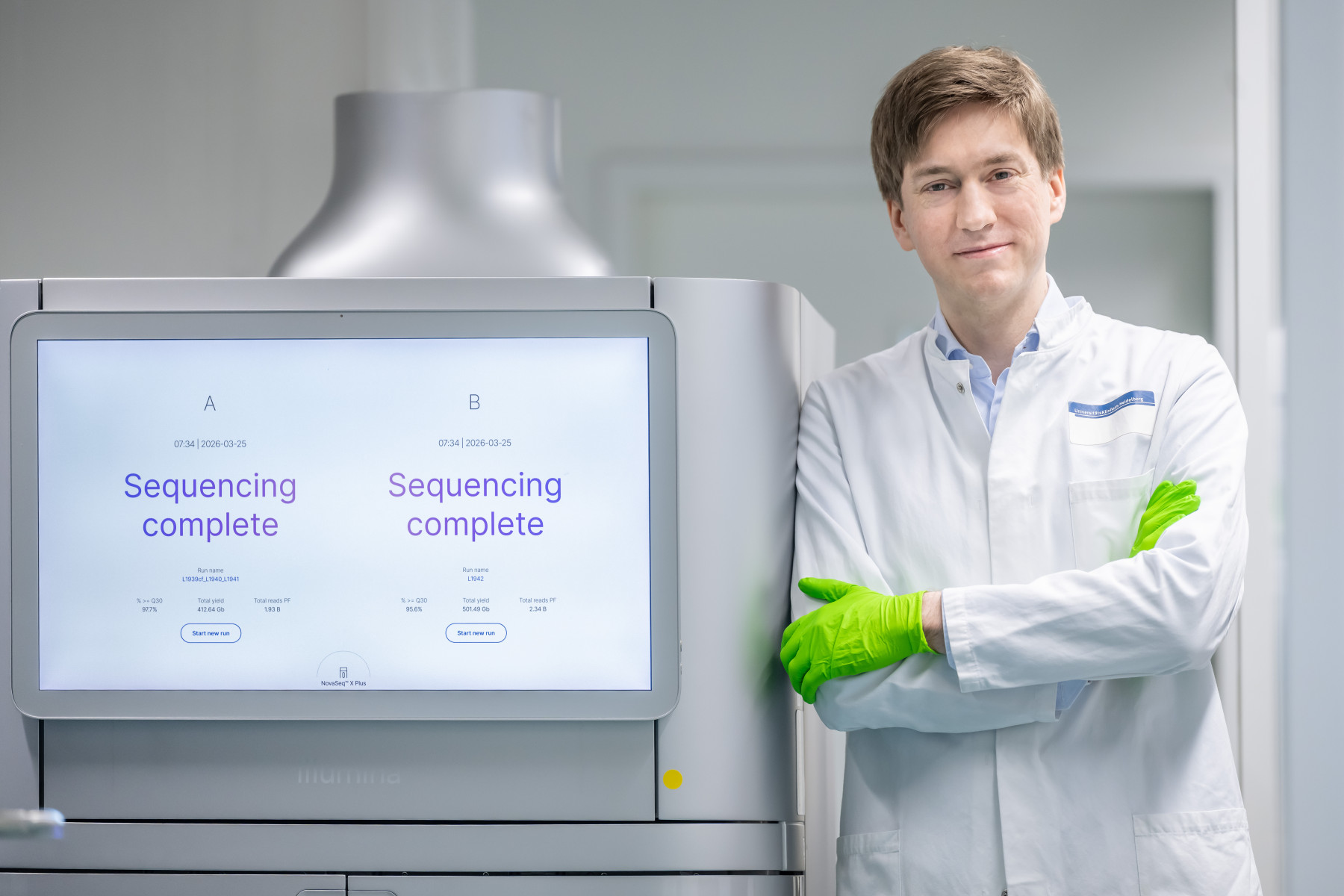
The German Cancer Prize in the “Translational Research” category recognizes scientific achievements with direct relevance to patient care that have been successfully translated into clinical practice. This applies par excellence to the classification system and analytical methods for meningiomas developed by neuropathologist Felix Sahm—a researcher at KiTZ and the Heidelberg Medical Faculty of Heidelberg University, as well as the Department of Neuropathology at Heidelberg University Hospital (UKHD)—and his team. He identified molecular markers on and within the genomes of tumor and immune cells that provide information about the aggressiveness of meningiomas and the further course of the disease, and developed several analytical methods combined with artificial intelligence (AI). Molecular classification is now recommended in international diagnostic guidelines and forms the basis for individualized treatment strategies and therapeutic research. He shares the prize equally with David Capper of Charité – Universitätsmedizin Berlin, who conducts similar research on other tumors of the central nervous system.
Molecular Classification of Brain Tumors Improves Diagnosis and Treatment
The starting point for Sahm’s work was a diagnostic “gap” in the assessment of brain tumors: While around ten years ago most types of brain tumors could already be precisely classified into different subgroups based on their molecular characteristics, no such system existed for meningiomas, the most common—and usually benign—brain tumors in adults. Aggressively growing meningiomas could not be reliably distinguished from benign ones based on the appearance of their cells, which affected the treatment strategy—specifically, the question of whether surgery should be followed by radiation therapy or not. Sahm developed the first molecular classification system for meningiomas based on specialized molecular genetic analyses, which proved reliable in several large-scale studies. An important distinguishing feature is so-called methylation, chemical changes on the surface of the tumor cell’s genetic material. This made it possible for the first time to distinguish between tumors that are identical in their DNA structure but very different in their disease progression.
30 minutes instead of two weeks and an “all-in-one” test for a single tissue section
Advances in machine learning have enabled significant leaps in the development of these diagnostic procedures in recent years: Together with colleagues at UKHD, KiTZ, and DKFZ, Sahm designed AI-supported classification methods for various applications and specific challenges in tumor diagnostics—for example, when results are needed quickly or when there are small amounts of evaluable tumor material.
Due to the complexity of the analytical procedures involved, the molecular analysis of a tumor sample can take up to two weeks. One of the new classification tools is based on so-called nanopore sequencing: a rapid method that can be performed on small, cost-effective devices to read the genetic information of tumor cells and identify characteristic chemical or genetic alterations. Once the genetic material has been extracted from the tumor cells, it provides an initial classification within 30 minutes. A comprehensive molecular profile of the tumor sample is available within 24 hours. The algorithm combines the “Rapid-CNS2” rapid test, which distinguishes 91 tumor classes, with “MNP-Flex” (Heidelberg Molecular Neuropathology (MNP) methylation classifier), which can evaluate the results of various analytical methods and identifies 184 tumor subclasses within 24 hours.
To enable the precise classification of very small tissue samples, Sahm, in collaboration with researchers at Erlangen University Hospital, further developed a method that had previously been used only for research samples: In “NeuroPathology Spatial Transcriptomic Analysis” (NePSTA), a single tissue section from the tumor is examined point by point on a special slide, simultaneously testing for several thousand cancer markers at a time. Artificial intelligence evaluates the data and can then simulate the results of various common analytical methods, effectively providing an “all-in-one” solution. This has two advantages: Even from small tissue samples—such as those from inoperable tumors—this method yields a wealth of information. Furthermore, the high spatial resolution allows even the smallest clusters of highly aggressive tumor cells to be detected—cells that are not detected by conventional methods but are relevant for tumor classification. Before NePSTA can actually be used in diagnostics, its practical applicability must still be verified in clinical trials.
Returning to Tissue Staining with Information from AI Classification
Most recently, Sahm and a team from Heidelberg University’s Medical Faculty, the German Cancer Research Center, and the National Center for Tumor Diseases (NCT) in Heidelberg demonstrated that the AI-generated classification of tissue samples from meningiomas is not based solely on the characteristics of the tumor cells. The immune cells that have migrated into the tumor tissue also significantly shape the molecular profile—and provide insight into the prognosis. This allows for a step “backward” in complexity: Traditional tissue assessment through staining of specific immune cell markers enables a rapid initial distinction between benign and malignant tumors, as well as an assessment of tumor grade, without significant technical effort. This finding also explains the biological basis of AI classification, making it more comprehensible.
Source (in German): UKHD